
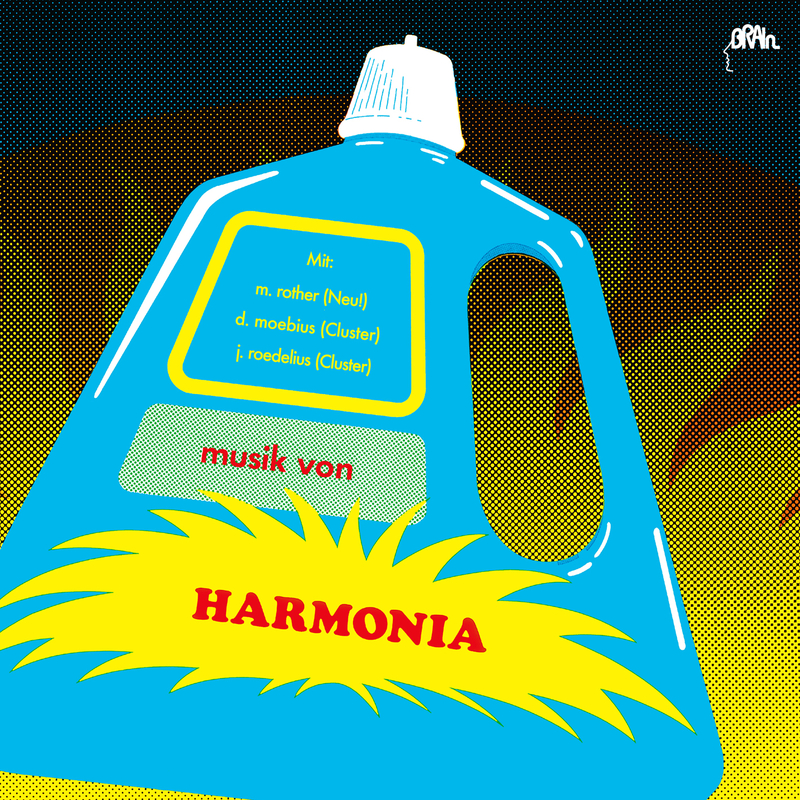
Harmonia – Musik von Harmonia (Brain LP, 1974)
1) Watussi; 2) Sehr kosmisch; 3) Sonnenschein; 4) Dino; 5) Ohrwurm; 6) Ahoi!; 7) Veterano; 8) Hausmusik
«The world’s most important rock group.» — Brian Eno, 1975
In 1973, Hans-Joachim Roedelius and Dieter Moebius of Cluster joined forces with Michael Rother of Neu! to form Harmonia, a group that has come to stand as one of the most influential bands of the 1970s. The music the trio created — alongside the catalogues of Cluster and Neu!, and of course Kraftwerk — proved decisive for everything from Bowie’s Berlin Trilogy to the progressive electronic music that emerged toward the end of the decade, and not least for synth pop. All members of Harmonia were in contact with Brian Eno, a man with a keen instinct for the finest obscurities. Cluster recorded several albums with the Englishman, and in 1997 Tracks and Traces appeared, featuring recordings made in collaboration between Harmonia and Eno. Older live recordings by Harmonia have also surfaced since. More on that later.
Harmonia began their collaboration with concerts while simultaneously recording their debut album Musik von Harmoniain Cluster’s studio in Forst, in rural surroundings roughly in the middle of Germany.
The record contained a near-perfect combination of Neu!’s rhythmic drive and electric guitars with Cluster’s electronic explorations as heard on Zuckerzeit. Despite occasional sharp edges, Harmonia’s music featured clear, uplifting melodies. They used rudimentary equipment and produced the album themselves with a simple mixing desk and three tape machines. The instrumentation included electronic percussion, piano, Farfisa organ, additional percussion, and electric guitars. The music was entirely instrumental. The Forst sessions were supplemented with a couple of live recordings later refined in the studio.
The trio may have relied on simple tools and a primitive studio, but the music they created was anything but simple. Musik von Harmonia combined immediate melodies with layers upon layers of sound. The sonic landscape was at times open, at others dense and heavy, yet always carried an uplifting quality far removed from gloom. The centerpiece “Sehr kosmisch” summed it up: the music was cosmic and expansive, yet accessible. The compositions united beauty with a tight, mechanical-industrial discipline.
Across the first three tracks the listener encountered proto-synth pop in “Watussi,” drifting spatial textures in “Sehr kosmisch,” and early industrial techno in “Sonnenschein.” Harmonia possessed a spontaneous freedom, with the three musicians listening to one another and feeling their way toward results rather than polishing pre-written compositions. This method closely resembled Cluster’s ethos, where “planned improvisation” shaped much of their work.
Roedelius and Moebius often brought a certain academic seriousness, while Rother contributed a more instinctive, devil-may-care attitude. None of the three dominated the sound completely; this was a genuine collaboration. If one presence stood out slightly, it was Rother’s, through the same characteristic, driving rhythm familiar from Neu!, especially audible in tracks such as “Watussi,” “Sonnenschein,” “Dino,” and “Veterano.” At the same time, there was ample room for the sonic territories Cluster had cultivated and would continue to develop. “Sehr kosmisch” revealed their least melodic side, while the angular, atonal “Ohrwurm” evoked cold steel, recalling their earliest releases. The beautiful “Ahoi!” pointed forward to the ambient and new age directions they explored on Sowiesoso in 1976 and on the subsequent recordings with Eno.
Rating: 9/10
 ROCKARKIVET