
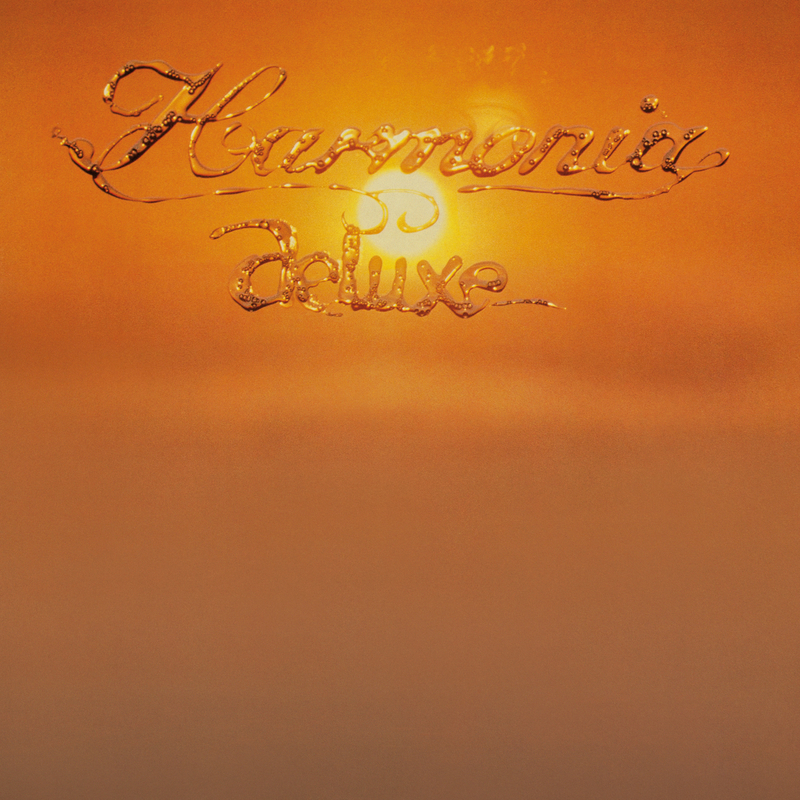
Harmonia – Deluxe (Brain LP, 1975)
1) Deluxe (Immer Wieder); 2) Walky-Talky; 3) Monza (Rauf und Runter); 4) Notre Dame; 5) Gollum; 6) Kekse
In June 1975 Harmonia recorded their second album and released it at the end of August the same year. The timing was perfect: Deluxe felt like late summer — warm, airy and dreamlike. As before, the music was recorded in Cluster’s studio in Forst, but although the overall sound was easily recognizable, much had changed since the debut. The simple taperecorder used on Musik von Harmonia had been replaced by a 16-track machine brought in by Conny Plank, who co-produced the album with the trio. Plank remains krautrock’s most important producer, with numerous landmark recordings to his credit, and having already worked with both Neu! and Cluster, he was a natural choice.
On the debut, a simple drum machine played a central role. This time it was far less dominant, appearing on only two tracks. Harmonia now had a very real drummer on board. They invited Mani Neumeier, one of the most influential drummers on the German music scene over several decades. He began in free jazz in the sixties before forming Guru Guru with Ax Genrich and Uli Trepte. The trio released several classic freak-rock albums in the early seventies, combining wild guitar flights with crushing rock power. Neumeier played with the drum machine as a metronome, ensuring the precise rhythmic pulse of the debut remained intact, while adding variations that gave Deluxe an extraordinarily lively feel.
The combination of Rother’s guitars, Moebius’ exploratory soundscapes and Roedelius’ gift for simple, lasting melodies once again formed a seamless whole — in fact, even more convincingly than before. The soundscape was more varied and, if not polished, more accessible and sweet-toned without becoming cloying. This was partly due to the more advanced recording equipment, but also to a greater emphasis on structured songs rather than pure improvisation. As the trio accumulated live experience, they developed melodic themes that they brought into the studio, forming the foundation for the album’s six tracks.
Side one consisted of two long pieces of around ten minutes each, and the first surprise arrived just one minute into the opening track: Harmonia sang. Vocals were used sparingly, but signaled a clear opening in the band’s expressive palette. Deluxe (Immer Wieder) was classic Harmonia: strongly rhythmic pop music with a sweet melody, enriched by guitars, keyboards and synthesizers. Here they recalled Kraftwerk, whose classic Autobahn had appeared the year before — an album that must have inspired Harmonia. Walky-Talky was no less effective, but different. Driven by Neumeier’s drumming and Rother’s subtly Eastern-tinged guitar lines, combined with the Cluster duo’s electronic shimmer, it created a gently bubbling, dreamlike whole.
Side two opened with Monza (Rauf und Runter), which, after a calm introduction, surged forward in a way that would have fitted Neu!’s 1972 debut. The remainder of the side consisted of shorter tracks where Cluster’s musical fingerprint was more prominent. Notre Dame was swirling proto-synth pop with hints of new age. Gollum was propelled by Neumeier alongside restless synthesizer chatter. Kekse closed a perfect LP with one of Roedelius’ small melodic gems, slowly building with fragments of noise and Rother’s guitar textures. At that point it was hard to disagree with Brian Eno’s claim that Harmonia were the world’s most important rock band.
Only two studio albums emerged from Harmonia before the collaboration came to an end. Cluster continued as a duo into the early eighties, releasing several strong albums in the late seventies — including collaborations with Brian Eno — before both members focused on solo work and other projects, with occasional reunions in later decades. Rother moved on to a solo career after both Harmonia and Neu! had run their course, debuting with the excellent Flammende Herzen in 1977.
Rating: 10/10
 ROCKARKIVET